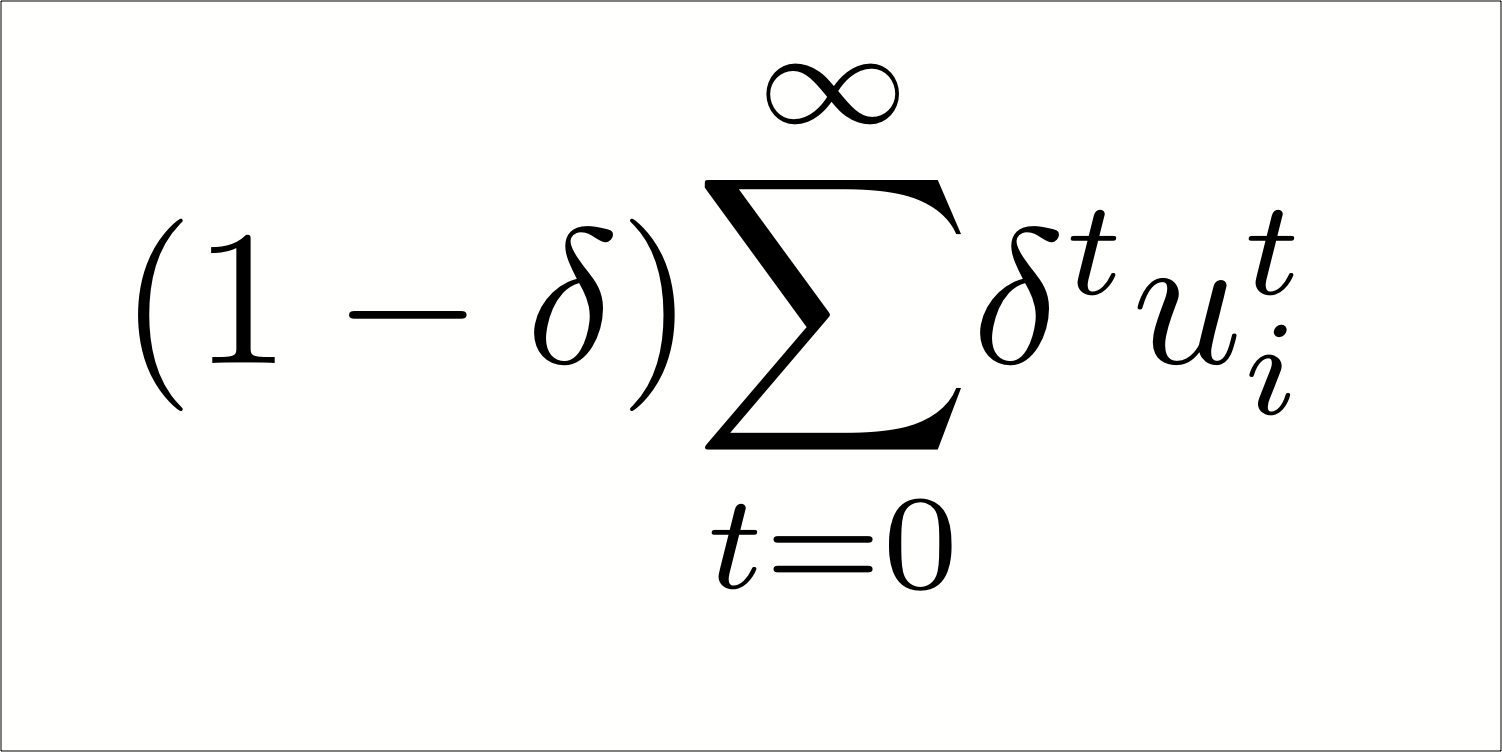
Chapter 5.2 of Jim Ratliff’s graduate-level game-theory course. When the stage game is repeated infinitely, we ensure the finiteness of the repeated-game payoffs by introducing discounting of future payoffs relative to earlier payoffs. Such discounting can be an expression of time preference and/or uncertainty about the length of the game. We introduce the average discounted payoff as a convenience which normalizes the repeated-game payoffs to be “on the same scale” as the stage-game payoffs. Infinite repetition can be key to obtaining behavior in the stage games which could not be equilibrium behavior if the game were played once or a known finite number of times. We show that cooperation is a Nash equilibrium of the infinitely repeated prisoners’ dilemma for sufficiently patient players. We show that cooperation in every period by both players is a subgame-perfect equilibrium of the infinitely repeated prisoners’ dilemma for sufficiently patient players.